
For many not-for-profit boards, or those charged with governance, the annual financial statements are reviewed once a year, accepted at a meeting, and then set aside. When used effectively, they are one of the clearest tools for understanding whether the not-for-profit has the flexibility, liquidity, and cash flow needed to carry out its mission. The examples below are intended to help those with oversight responsibility know what to look for when reviewing the statements and identify thoughtful questions to ask management.
Statement of Financial Position
The statement of financial position is a snapshot of what the not-for-profit owns, owes, and has available at a specific point in time. Net assets represent what remains after obligations are paid and help show the financial cushion available to carry out the mission.
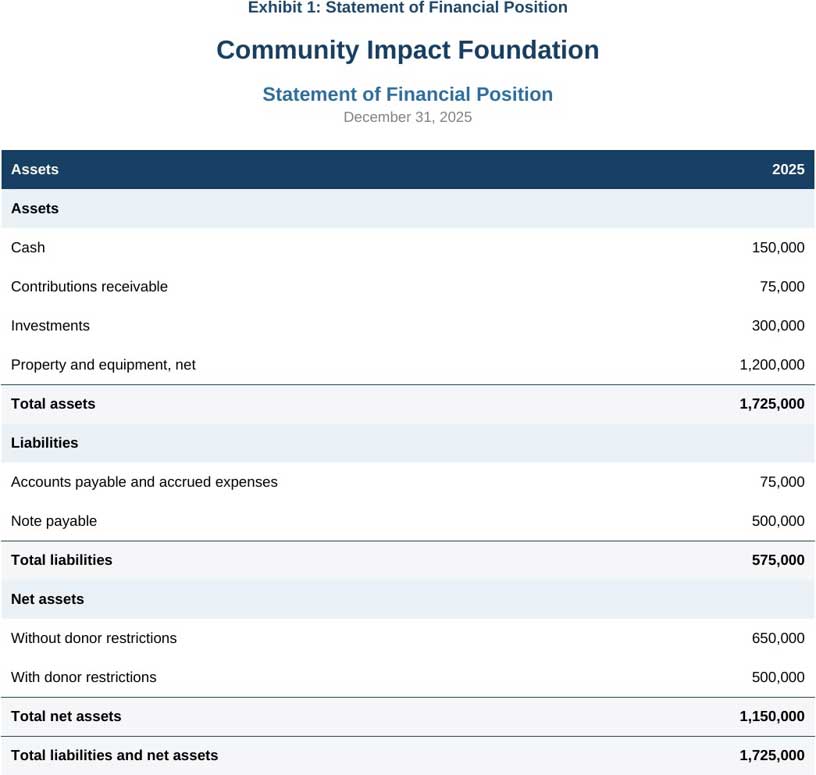
Exhibit 1 shows total assets of $1,725,000, liabilities of $575,000, and net assets of $1,150,000. Of that balance, $650,000 is flexible and generally available for operations, while $500,000 is limited to specific donor-approved purposes.
Understanding that only $650,000 of the $1,150,000 in net assets is flexible helps the board distinguish between resources available for general operations and amounts set aside for donor-approved purposes.
The footnotes can provide additional context that may not be visible in the primary statements, including whether reported assets are available, when obligations come due, and where future financial pressure may arise.
Related note disclosure: liquidity and availability of assets:
Liquidity is the ability to access financial assets quickly enough to pay bills and continue operations. Cash, investments, receivables, and expected contributions may improve liquidity, but not all amounts are available for general use.
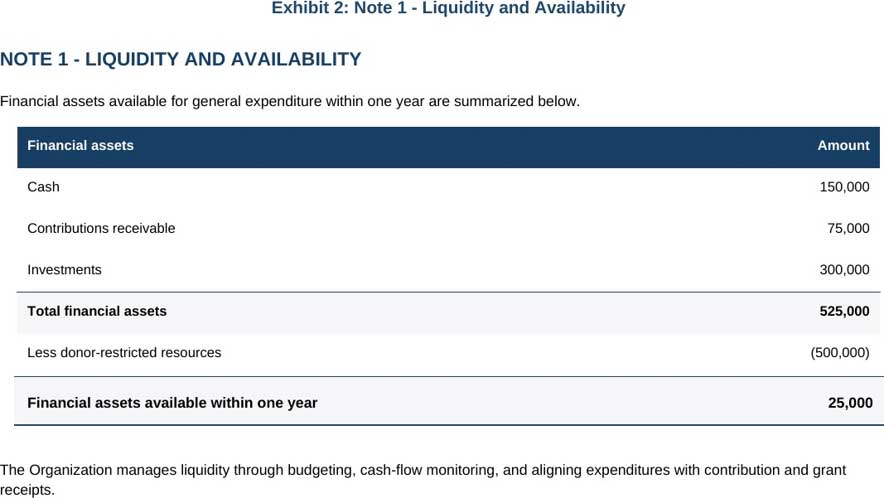
Exhibit 2 shows that only $25,000 is available within one year after restrictions. Strong liquidity gives leadership room to manage delayed payments and unexpected costs. Limited liquidity may require management to delay spending, draw on a line of credit, or reconsider planned investments.
Related note disclosure: long-term obligations:
Debt and leases can advance the mission, but they also create required payments that continue even if grants are delayed or fundraising declines. Key considerations include the total amount owed, the timing of payments, and the effect those payments may have on programs, staffing, and reserves.
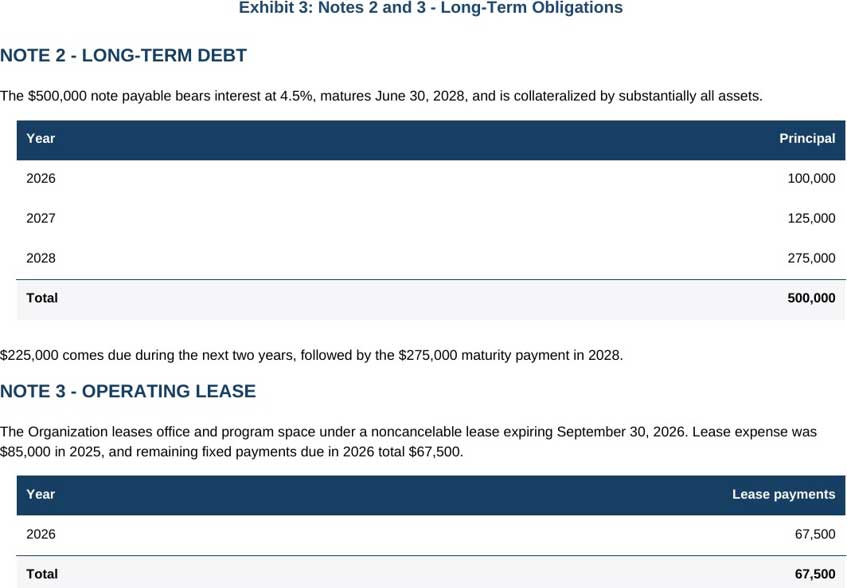
Exhibit 3 shows debt payments due through 2028 and lease costs through September 2026, helping to anticipate cash needs and decisions about refinancing, renewing the lease, or relocating.
Related note disclosure: donor restrictions:
Restricted contributions must be used for the purpose, program, or period specified by the donor. Growing restricted balances may reflect strong donor confidence, but they may also point to delayed programs or unmet donor conditions. An important consideration is why contributions are restricted and when management expects those restrictions to be satisfied.
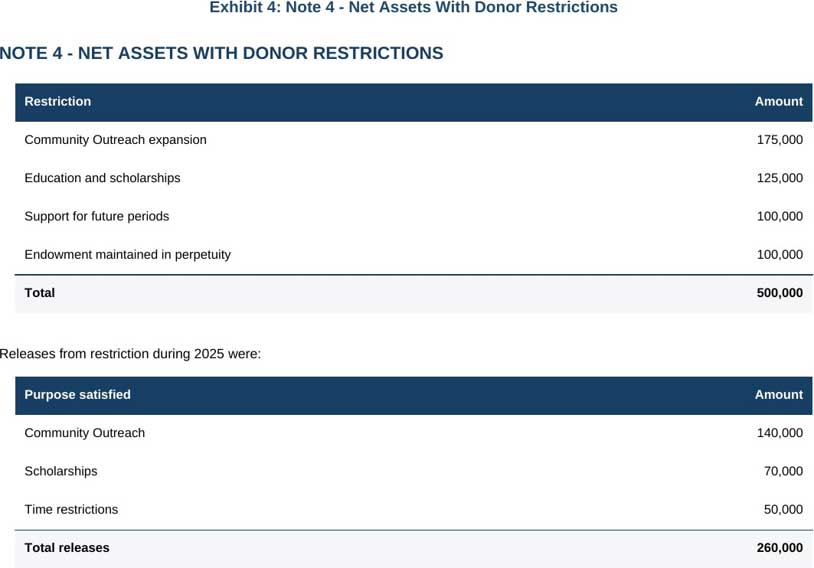
Exhibit 4 breaks down the $500,000 restricted balance and $260,000 released from restriction during the year. This helps show how much is set aside for specific purposes and whether those dollars are moving into programs as expected.
Questions for management
- Is there enough cash and flexibility for near-term needs?
- Can upcoming debt and lease payments be managed without affecting programs?
- What still needs to happen before restricted contributions can be used?
Statement of Activities and Changes in Net Assets
The statement of activities shows revenue, expenses, and whether the not-for-profit ended the year with a surplus or deficit. A surplus may help pay for future programs or build reserves, while a deficit should prompt questions about its cause and whether reserves or borrowing were needed.
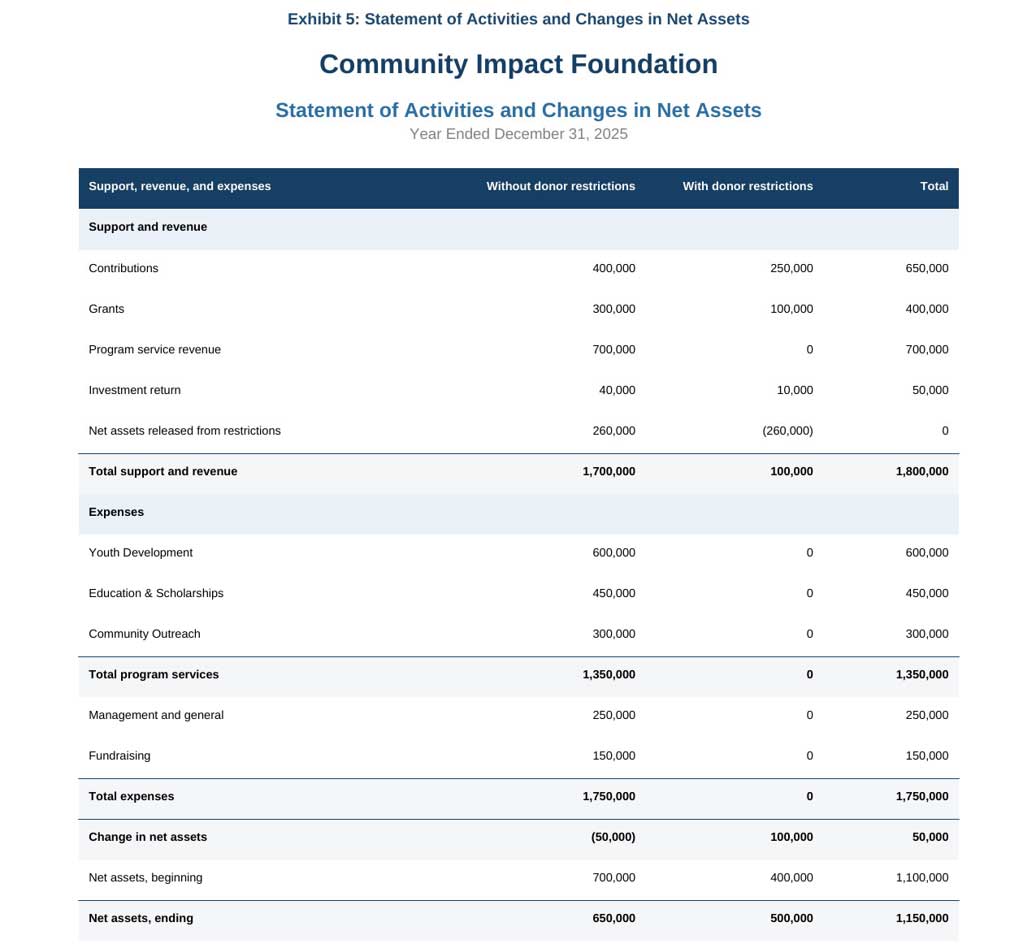
Exhibit 5 shows $1.8 million in total revenue, $1.35 million utilized in program services, and $50,000 remaining after expenses. The surplus is positive but narrow, making it important to consider whether current spending can continue if conditions change.
Related note disclosure: revenue concentrations
A not-for-profit’s revenue mix may include contributions, grants, government contracts, program service revenue, investment income, and fundraising events. The financial picture can look strong while still carrying significant risk if a large share of revenue depends on one donor, grant, contract, or event.
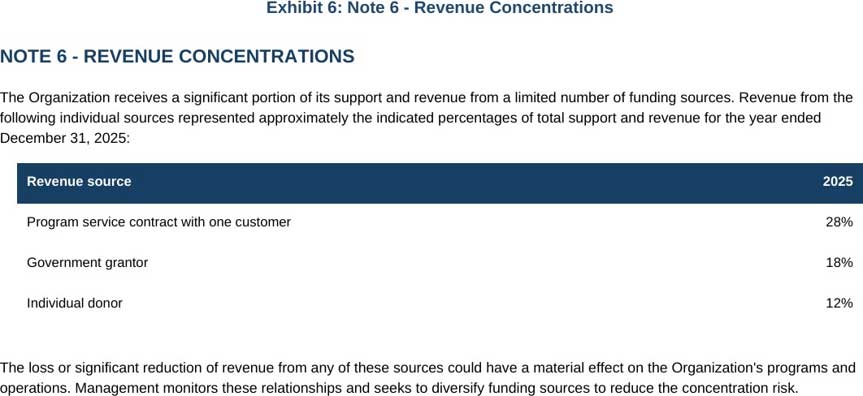
Exhibit 6 shows that three major revenue sources account for about 58% of total revenue. One program service customer represents 28%, which highlights the need for a realistic plan if a major relationship changes.
Questions for management
- Can current spending continue if revenue changes?
- Are we too dependent on a few major revenue sources?
Statement of Functional Expenses
The statement of functional expenses shows both what was spent and whether those costs supported programs, management, or fundraising. This helps evaluate whether spending aligns with the mission and whether leadership is investing enough in the people and systems needed to operate effectively.
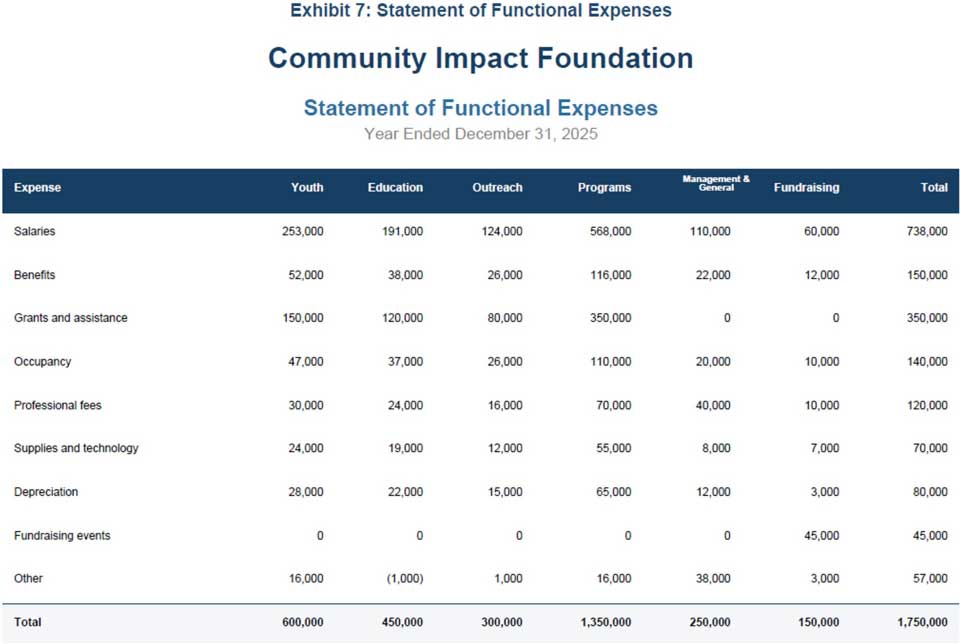
Exhibit 7 shows that most spending was directed to programs, with Youth Development as the largest program. Salaries and wages were the largest cost category at $738,000, or about 42% of total expenses, making staffing and workforce planning important to future financial stability.
There is no single “perfect” program versus administration percentage. While an 80% program and 20% administration split is a common benchmark, the better question is whether spending reflects the mission, supports needed talent and systems, and remains sustainable.
Questions for management
- Are current staffing costs sustainable if revenue or program demand changes?
- Is Youth Development program spending achieving the intended impact?
Statement of Cash Flows
A positive change in net assets does not always mean cash increased. Revenue may be recorded before cash is collected, expenses may be paid at different times, and equipment, facilities, or investment purchases can reduce cash without appearing as expenses on the statement of activities. The statement of cash flows shows whether financial results produced enough cash to pay bills, keep programs running, meet obligations, and plan ahead.
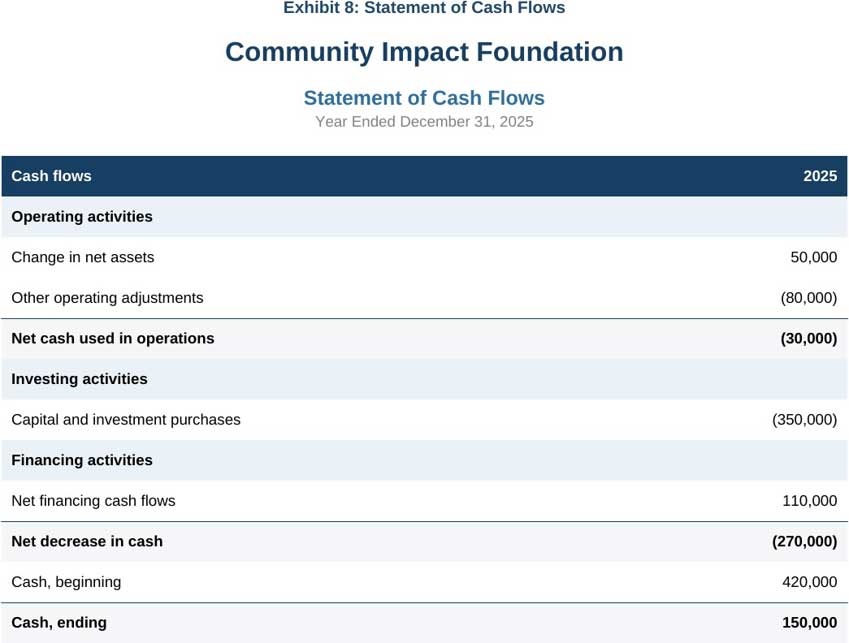
Exhibit 8 shows that operations used $30,000 of cash, longer-term purchases used $350,000, and financing activities provided $110,000. The net result was a $270,000 decrease in cash. In this example, the cash flow statement changes the story: the not-for-profit reported a surplus, but normal operations still used cash during the year.
Questions for management
- What was purchased with the $350,000, and how will it help support the mission?
Move from Acceptance to Oversight
The statements will not dictate specific decisions, but they can highlight strengths, risks, and issues needing attention. In this example, the results were positive, but the exhibits also showed a narrow surplus, declining cash, limited liquidity, upcoming obligations, and reliance on a few major revenue sources. Together, the statements help board members or those charged with governance ask better questions, protect the mission, and guide informed decisions.
To learn how your financial statements can become a stronger oversight tool, contact a CBIZ CPAs professional for guidance.
CBIZ CPAs P.C. All rights reserved. Use of the material contained herein without the express written consent of the firms is prohibited by law. This publication is distributed with the understanding that CBIZ is not rendering legal, accounting or other professional advice. The reader is advised to contact a tax professional prior to taking any action based upon this information. CBIZ assumes no liability whatsoever in connection with the use of this information and assumes no obligation to inform the reader of any changes in tax laws or other factors that could affect the information contained herein. Material contained in this publication is informational and promotional in nature and not intended to be specific financial, tax or consulting advice. Readers are advised to seek professional consultation regarding circumstances affecting their organization.
“CBIZ” is the brand name under which CBIZ CPAs P.C. and CBIZ, Inc. and its subsidiaries, including CBIZ Advisors, LLC, provide professional services. CBIZ CPAs P.C. and CBIZ, Inc. (and its subsidiaries) practice as an alternative practice structure in accordance with the AICPA Code of Professional Conduct and applicable law, regulations, and professional standards. CBIZ CPAs P.C. is a licensed independent CPA firm that provides attest services to its clients. CBIZ, Inc. and its subsidiary entities provide tax, advisory, and consulting services to their clients. CBIZ, Inc. and its subsidiary entities are not licensed CPA firms and, therefore, cannot provide attest services.